



social media marketing

5 Ethical Ways Female Founders Can Master Social Media Without Burnout

As female founders, we wear a thousand hats.

But for many, social media often feels like the one we handle with the least confidence.

I often speak about not having to chase trends or use manipulative tactics to grow online.

Ethical marketing is rooted in honesty, value, and connection. At its heart, it builds trust that lasts longer than a viral post. And when you pair it with storytelling, you unlock your superpower: the ability to connect deeply, inspire action, and turn followers into loyal supporters.

If you’re reading this feeling like you’re in over your head, remember you’re not alone. If you’ve ever felt overwhelmed by the algorithm, unsure what to post, or simply exhausted from trying to do all the things. This blog post is your reminder to bring simplicity, clarity, and intentionality to your social presence.

Here are five ways to master social media without pressure and burnout:

1. START WITH YOUR WHY

Ethical marketing begins with clarity of purpose.
Ask yourself:

  • Why did I start using social media for my business?

  • What do I want my audience to feel when they interact with me?

  • Am I creating to be liked, or to be remembered?

That question is your north star, especially when algorithms change or comparison creeps in. When your “why” is clear, your content has direction, and your strategy feels authentic rather than forced.

Photos courtesy of Karen Staniland-Platt

2. YOUR PROFILE IS YOUR PITCH

In seven seconds, people decide whether to follow, explore or move on. There are small tweaks you can make (like a clear bio, a strong call-to-action, and high-quality images) that can increase engagement dramatically.

Here’s my simple 3-Part transformational formula to elevate your bio, include:

  • Who you help

  • How you help

  • Proof of impact or personality

For instance, instead of “Wellness Coach | Mom | Smoothie Lover,” try:
“Helping exhausted mums reclaim energy through nutrition + mindset | 100+ clients thriving.”

That clear, honest and customer-focused clarity in your bio can shift curiosity into connection, and elevate your click-through rates.

3. CREATE CONSISTENTLY, NOT CONSTANTLY

Posting every day isn’t the goal.

What you do need is a repeatable, flexible and sustainable routine that honours your life and your values.

My 3C Method helps founders avoid burnout:

  • Clarity: Define three content pillars (e.g. Add your personality, Share your purpose, Don’t forget to promote your services / products).

  • Calendar: Batch posts and repurpose to save time.

  • Confidence: Focus on being helpful and in service of others, not perfection. Engage in DMs and comment authentically. That way even if you aren’t posting, you’re still active online.

What you’re doing through this method is building visibility through connection without sacrificing your wellbeing.

4. MAKE FEATURES WORK FOR YOU (NOT AGAINST YOU)

You don’t have to be everywhere. But you do need to be deliberate where it matters.

Consider who your ideal clients or customers are and how they would spend time on social media.

For example, you could leverage platform features like Reels, Stories, Interactive Stickers, and LinkedIn’s Featured Section to connect with your audience in different ways.

Or repurpose one idea into multiple formats. Example: “How I Started My Business” can become:

  • An Instagram carousel

  • A TikTok video with three tips

  • A Facebook Story with a poll

  • A LinkedIn post with a call-to-action to your latest blog

Sprout Social confirmed that people who see your content across 3 or more formats are 70% more likely to buy from you.

So this approach maximises reach while keeping your workload light.

5. MEASURE THE METRICS THAT MATTER

Ethical marketing means focusing on meaningful results, not vanity metrics. Knowing which content drives action helps you double down on what works and let go of the rest.

Go back to your “why”. Why did you start marketing on social media and what will help you achieve your goals?

  • Growth: Reach, profile visits, increasing follower numbers

  • Connection: Saves, shares, DMs

  • Conversion: Website clicks, inquiries, bookings or sales

Keep an eye on what content sparks DMs, prompts profile visits or an increase in shares, that’s your bread crumb trail to real results.

I shared these 5 ethical tips at a recent Social Media 101 Masterclass for the Female Founders Rise community who are empowering more than 10k women and non-binary entrepreneurs to build their visibility and scale their businesses with purpose.

BOOK ME AS A SPEAKER

If you're ready to stop spinning your wheels and start growing with meaning, start with one small, aligned step, even if it just means rewriting your bio or planning one week of posts ahead.

Or …

BOOK A 1-2-1 COACHING HOUR WITH ME


8 Top Tips to manage your socials over the holidays

While the country begins to wind down for the six week Summer holiday break here in the UK, Social Media Marketers are frantically beavering away to make sure their clients’ social media profiles are not on holiday.

Photography by Caz Saramowicz

Here are my 8 Top Tips to keep things ticking over:

  • Understand how your audience will be using social media. Which platform would be best to focus on with less time on your hands.

  • Plan and schedule you social media posts in advance. Schedulers are great to be able to plan and post automatically while you’re away. Either use platforms native to the platform you’re using or third-party tools such as Later, Sprout Social, Buffer, Hootsuite or Agorapulse for example.

  • Prepare your customers in advance that you will be away to manage expectations. Update your website, social media platforms, Google Business Profile page and other automated responses with your opening times.

  • Update your website information for customers to still refer to with summer deals, discounts or topical blogs for this time of year.

  • If you do choose to check in over the holidays, use that time to check in with your audience, like, follow, comment and engage with their content as well brands and partners you love

  • Use more video on the go - Stories, Reels, Lives, TikTok videos are quick, easy and fun to make. They don’t need to be polished and can show your audience a different side to your brand personality.

  • Use this time to think about new, creative and innovative ways to connect with your audience. The next phase of the year offers a change of season and a very quick countdown to Christmas. Review the content you’ve previously posted, how can you breathe new life into your images, videos, tone of voice and branding.

  • Turn off notifications on your phone and genuinely unplug.

Actually take time off! You deserve it. I try to only post after my holiday has finished, so I’m fully present while we’re on a break.

When you're ready to return, perhaps start with a few snapshots or highlights from your break and ease your way back online.

Flamingo image

Truly unplugging from social media is the only way to get a genuine rest. Not to mention the pressure to share on social media takes you out of the moment. Set your own boundaries. Try and stay present rather than stressing about what filter to use. 

“A boundary is not that at which something stops, but that from which something begins” - Martin Heidegger.


Need some help with planning content on your return to the office? I’m freeing spaces during September for power hours, so let’s get you sorted.

Book an hour with me
Last year I felt that my social media was lacking. I booked a power hour. It was the best thing. I got an individualised breakdown assessing my Facebook Business Page. I was so impressed with Yolanda’s detailed information. What was even more thorough was the inclusive and accessible feedback.

Five stars from me!
— Jennifer Smith, Motivational Speaker

5 Ways to Be Braver in Business

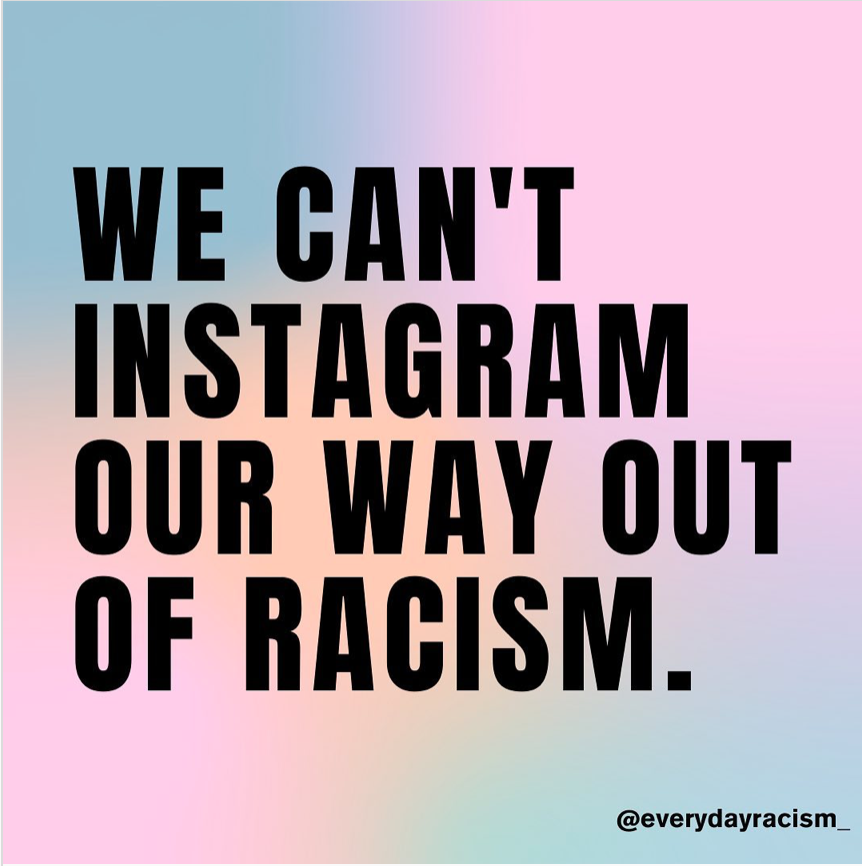
Do you remember 2020? When tons of little black squares flooded social media in “solidarity”? When the world collectively went silent and shared their outrage at the murder of George Floyd on Black Out Tuesday?

Image credit - Taken from this brilliant post from Every Day Racism’s Instagram Profile

Image credit - Taken from this brilliant post from Every Day Racism’s Instagram Profile

According to Forbes, over 28 million Instagram users participated in #BlackoutTuesday — collectively posting empty black tiles. For the first time in decades, brands, organisations and individuals collectively took a stand to drive change.

2020 is arguably the year of the 21st Century for global activism and honestly, it seems to be a great thing. The last year and certainly events in recent months have left me wondering … does activism have a place in business?

I’ve seen this managed successfully by some of the bigger brands and dismally by others.


Brands like Dove, Nike and Heineken for instance, have taken a public stance on social issues from the environment, politics, gender issues, racism and in the case of HSBC even Brexit.

But what does Brand Activism mean? 

Brand activism is when a brand takes a stand to help drive change to help solve the most urgent problems facing society (social, economic, environmental or political) — based on its own beliefs, purpose and values. It isn’t a new concept, however with the rise of conscious consumerism, companies are noticing that by stepping away from the fence, they can broaden their reach and drive sales.

We’ve seen this nearer to home too. In the wake of Marcus Rashford’s child poverty campaign, smaller independent businesses and charities were galvanised to provide free school meals to struggling families last year. It led to overwhelming consumer support for participating restaurants & charities during lockdown and eventually a U-turn from the UK government on it’s decision not to fund holiday feeding schemes.

Do consumers care?

According to Sprout Social, 70% of consumers feel it’s important for brands to take a stand on public issues, a sentiment that’s grown 6% from 2017. 

Edelman’s Trust Barometer also finds 81% of consumers say they expect brands to do the right thing, and 71% say that placing profit before people will lose their trust forever. Generation Z are voting with their wallets for businesses that are authentically purpose driven. Gen Z Believes in it’s own power to make change and are expecting companies to lead the way.

Blog Banner images-2.png

Generation Z uses social media not only to learn about issues, but to make a meaningful difference. 91 percent say they use social media to learn about and participate in issues they care about

BBMG and GlobeScan asked more than 27,000 people across 27 international markets to share their experiences over the last year and the report highlights that young people under age 30 are more likely to reward brands when they take meaningful action.

They’re looking to their peers. Think about the impact of historic moments led by US Olympic gymnast Simone Biles, Grand Slam Tennis champion Naomi Osaka, and Climate Campaigner Greta Thunberg to move the world to a different way of taking action.

Believe me when I say that I’m not advocating that businesses should all grab their megaphones and publicly share their views on issues. Instead can you share your values in a way that is effective and that will bring about real change?

MY TOP 5 TIPS TO BUILDING BRAND AUTHENTICITY

Consumers can see through activism that is performative. Brand activism needs to be authentic and businesses need to ensure they are not ‘purpose washing’ or ‘jumping on the bandwagon’ of a cause that appears popular and trendy. The odd comment, like or share on your social media does not translate as brand activism. 

My advice to business is to make sure that your business values align with the purpose and causes you support. It is not an easy thing to address, but here are some strategic steps to explore beforehand:

1. Start internally

Think about the key social issues you care about and how it fits or does not fit with your stated corporate values. Involve colleagues, co-workers and, if you are a sole trader, your friends and influencers in discussions to make sure your internal values are aligned to your public statements.

2. Define your purpose

Do not try and tackle everything at once, you’re bound to drop the ball. Start by choosing one cause you’d like to focus on, and from there, you can then expand as you gain credibility.

3. Air your dirty laundry

In other words, be authentic. Admit when you’ve been wrong in the past. It’s better to reflect on when you’ve done wrong and have a plan to change than to cover it up with performative activism.

4. Research. Research. Research.

Understand the complexities. Team up with a charity or not-for-profit organisation, work with them to understand the complexities that exist surrounding the issues you are compassionate about. By doing so, you’re able to identify which area, within the cause, you want to channel your activism. This can focus your attention and help you to define your area of impact. 

Don’t forget to be strategic in your approach and identify the potential risks. Do your research so that you are clear about the factors that will impact your ability to facilitate change. Anticipate mistakes and put in place feedback facilities so that you can quickly respond. Keep doing this, so that your approach evolves along with your business practices.

5. Show some results

Turn your purpose into action. Empower Others, Not Yourself! Remember that business activism around social change is not about gaining press coverage or increasing profits. The impetus should be influencing change for your wider community and the world at large.

One way you can do this, is to work with people of influence, people of extensive knowledge in the area - staff, colleagues, board members, associates, partners, consumers - ensuring you come together with aligned values and share a commonality in what you’re trying to achieve.

ITS OKAY TO BE NERVOUS

Blog Banner images.png

Again, brand activism may not be for everyone, but statistics have found that when consumers think a brand has a strong purpose, they are 4.1 times more likely to trust the company

When brand activism is done well, it becomes a genuine and authentic extension of the company culture and business values are not only advocated by leadership teams, but wider employees too. 

I personally think that activism does have a place in business. It helps to attract talent, attract partnerships, attract investment and attract sales. For it to be sustainable, it requires real commitment from the top down to infuse the essence of the cause into every facet of the organisation, including marketing.

It empowers every part of the organisation to do their part in making right, even in a small way, some of the horrible injustices of this world.

It isn’t about political correctness or “woke”, it’s about being braver and making genuine connections with your customers.

People already care and it’s our job to make it easier for them to do so and take action.

Ready to discuss your purpose?